Protecting Children Begins with Awareness: A Call to Action During Child Abuse Prevention Month
Each April, organizations, across the country, come together to recognize National Child Abuse Prevention Month. At The Barker Adoption Foundation, this month serves as a renewed call to action to reflect on the systems, supports, and strategies that can help all children grow up safe, supported, and loved, as well as a solemn reminder that not all children do.
Child abuse and neglect impact every community. While the headlines often focus on the most extreme and visible cases, thousands more instances go unseen, unheard, or unreported—leaving children vulnerable, families isolated, and professionals unsure of how to intervene.
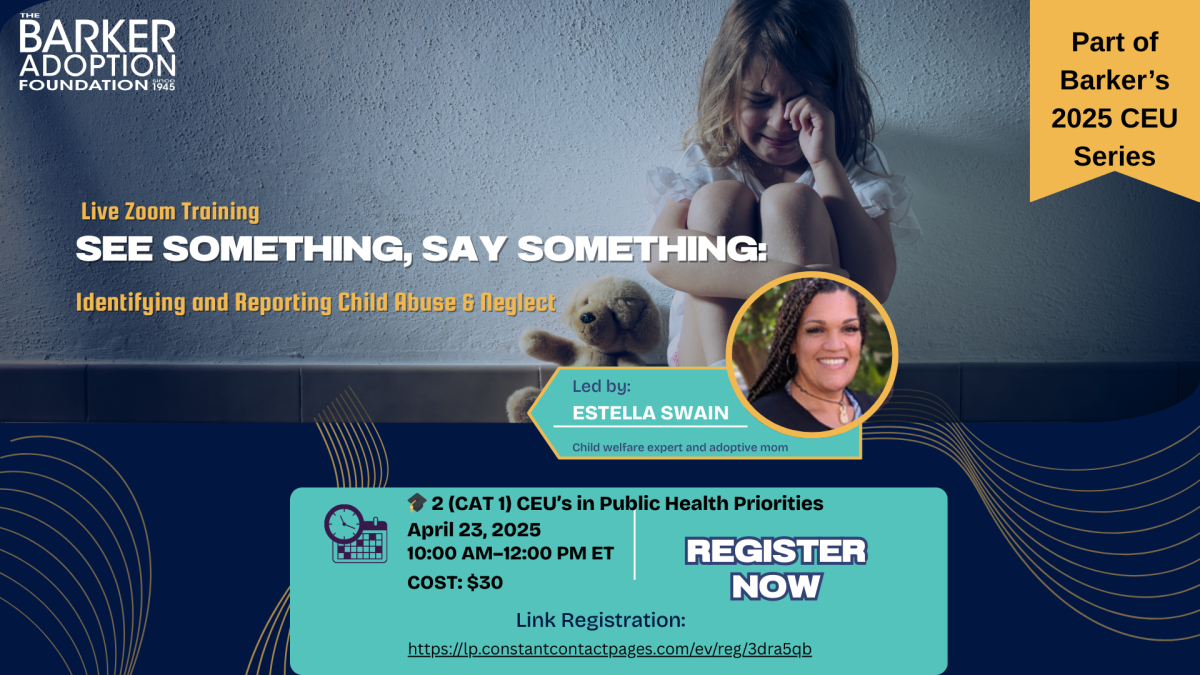
On Wednesday, April 23, from 10:00 AM to 12:00 PM (ET) via Zoom, Barker will be offering See Something, Say Something: Identifying and Reporting Child Abuse & Neglect, led by expert trainer Estella Swain. This will be a timely and essential training for social workers and professionals who work with families. This workshop provides 2 Category 1 CEU’s for social workers and can be used to meet the DC Health Public Health Priorities requirement.
Much more than a professional development opportunity, this workshop will serve as a tool to help attendees take responsibility for the safety and well-being of children in our homes, schools, and communities.
Please use the link below to register today!
The Quiet Epidemic: Understanding the Scope of Abuse
According to the U.S. Department of Health and Human Services, in 2022 more than 600,000 children were victims of abuse or neglect in the United States. That is one child every 52 seconds. These numbers represent real lives—children navigating trauma and instability, without access to safe adults they can turn to for help.
Neglect is the most common form of maltreatment, followed by physical, emotional, and sexual abuse. But because child abuse doesn’t always leave bruises, the signs aren’t always clear. A child’s withdrawn behavior, poor hygiene, aggressive outbursts, or extreme compliance may be cause for concern and point to deeper harm, and without proper training, even the most well-meaning professionals can overlook these potential red flags.
In foster care and adoption spaces, the stakes are even higher. Children who have already experienced trauma are at increased risk of re-victimization if their environments lack the stability, advocacy, or trauma-informed care they desperately need.
Why Do I Need Child Abuse Training?
The goal of this month’s CEU workshop is to equip professionals with the tools to:
- Recognize subtle warning signs of abuse/neglect
- Understand the impact of trauma on behavior and development
- Navigate mandated reporting laws with clarity and compassion
- Respond to disclosures with empathy and effectiveness
- Build trust while maintaining appropriate boundaries
Trainer Estella Swain brings decades of experience to the session, offering a mix of research, case examples, and actionable strategies. Whether you work in adoption, education, healthcare, social services, or community outreach, this training will expand your confidence and deepen your competence in protecting vulnerable children.
If you're a social worker licensed in DC, this session counts towards your Public Health Priorities requirement, making it both timely and practical for your continued learning goals.
Creating a Culture of Protection
Child abuse prevention is a collective responsibility. Parents, neighbors, educators, spiritual leaders, and caregivers all play a role in creating communities where children are safe.
How do we move from awareness to action? Here are five steps to consider:
- Believe children when they share—and listen without judgment.
- Educate yourself and others about the signs of abuse and trauma.
- Check-in with families, especially those facing stress, isolation, or transition.
- Report when something feels off, even if you're not sure. It’s better to be wrong than silent.
- Advocate for policies that strengthen child welfare systems, increase access to mental health services, and support at-risk families before abuse occurs.
Truth, trust, and transparency are the foundation of our work with adoptive and foster families. Those same values guide our prevention work. When children are surrounded by adults who tell the truth, build trust, and create transparent expectations—they thrive.
Building Your Skills, Deepening Your Impact
Your commitment to child abuse and neglect training is more than checking the box. It’s a chance for you to recalibrate your lens and sharpen your instincts. Often, it's the smallest signs—a child’s sudden change in mood, a missed appointment, a shift in affect—that can signal something more.
If you're a professional who interfaces with children or families, or someone who cares about the children in your community, we encourage you to register for this essential training. You will take away practical tools, a clearer understanding of your legal responsibilities, and a renewed sense of purpose.
During a time when headlines can feel overwhelming, trainings like this remind us that change starts with the choices we make in our everyday interactions—with our clients, our students, our neighbors, and our own children.
Join Us
Workshop: See Something, Say Something: Identifying and Reporting Child Abuse & Neglect
Date: Wednesday, April 23, 2025
Time: 10:00 AM – 12:00 PM ET
Location: Live Zoom Training
CEUs: 2 (CAT I) – Can be applied to DC’s Public Health Priorities requirement for social workers
Facilitator: Estella Swain, LCSW-C
Together, let’s build safer, more informed communities where children are not only protected but cherished.
Additional Resources
- Child Welfare Information Gateway – Prevention Resource Guide
- DC Mandated Reporting Requirements
- The Barker Adoption Foundation Counseling Services
- For more information about Barker Adoption Foundation’s CEU Series, contact organizer Virginia Downes at (301) 664-9664 or vdownes [at] barkerfoundation.org